
In Vivo DMPK (Drug metabolism & Pharmacokinetics) Services

Pharmacokinetic Profiling & Biodisposition to Support Nonclinical Drug Development
In vivo DMPK studies are critical for understanding how a drug candidate behaves in a biological system, including absorption, distribution, metabolism, and excretion. At GBA Group, our experienced nonclinical team delivers customized in vivo DMPK solutions that produce high-quality data to support Lead Optimization Phase, PK/PD modeling, and regulatory strategies.
Why In Vivo DMPK Matters ?
In vivo pharmacokinetics and drug metabolism evaluations provide essential insight into how compounds perform in complex biological environments. These studies help you:
• Determine systemic exposure and elimination profiles
• Evaluate bioavailability and first-pass effects
• Characterize tissue distribution and organ exposure
• Quantify major metabolites relevant to safety and efficacy
• Inform dose selection for toxicology studies
Our In Vivo DMPK Capabilities
Study Designs & Species examples
We provide in vivo DMPK studies primarily in rodents, but not exclusively with comprehensive dosing and sampling strategies. Study designs are tailored to your compound’s properties and project needs, including:
• Our in vivo capabilities (GLP and nonGLP) span rodent and non-rodent models, supporting nonclinical development programs from early discovery to regulatory studies. Species selection is tailored to scientific, ethical and regulatory requirements.
• Single, repeated, or cassette dosing formats
• A wide range of administration routes(IV (bolus or infusion), oral (liquid, capsules), subcutaneous (incl. osmotic – minipumps), intraperitoneal, intramuscular, intradermal, intranasal, topical, intravitreal, intraportal, inhalation) with single, repeated and cassette dosing.
Pharmacokinetic (PK) profiling of biologics
For PK studies of biologics, the choice of the animal model has a significant impact on the translational relevance of the data. We use the double knock-in hSA/hFcRn mouse model which expresses both human serum albumin (hSA) and human neonatal Fc receptor (hFcRn) under physiological control, providing a more human-relevant system for PK assessment.
Commonly used FcRn models such as Tg32 or Tg276 rely on random transgene insertion of human FcRn while retaining murine serum albumin. This mismatch can influence FcRn–ligand interactions, albumin competition, and Fc-mediated recycling, potentially affecting clearance and half-life predictions for antibodies, Fc-fusion proteins, and albumin-binding biologics. By expressing both human FcRn and human serum albumin, our model more accurately reflects the human FcRn–albumin–IgG axis, enabling improved assessment of:
• Fc-dependent recycling mechanisms
• Albumin and IgG half-life
• PK behavior of Fc-engineered or albumin-binding biologics
This results in more predictive PK data extrapolation and reduced translational uncertainty when progressing biologics toward clinical development.
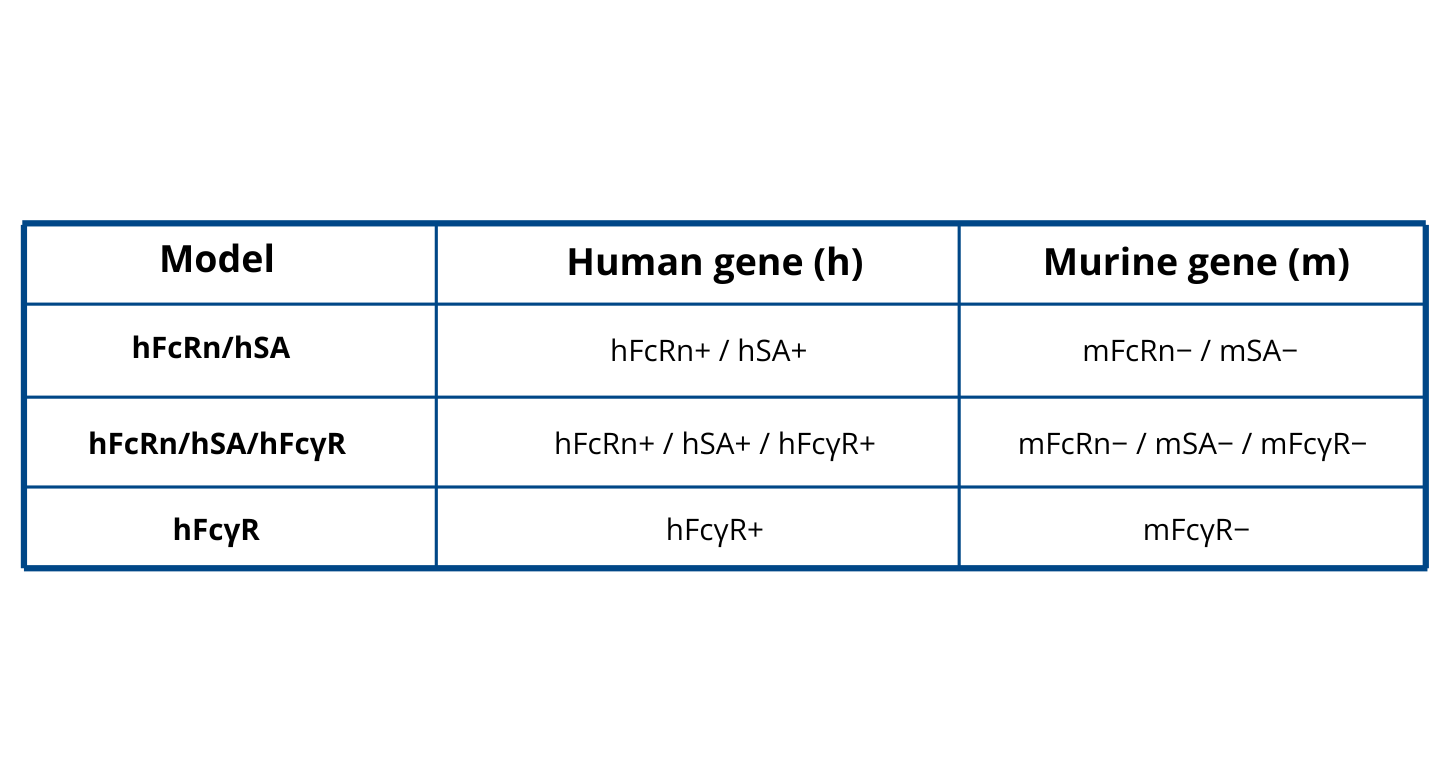
Headline
“+”: gene expressed, “-”: gene not expressed; FcRn: neonatal fragment crystallizable (Fc) receptor; SA: Serum Albumin; FcɣR: Fc gamma receptor.
“+”: gene expressed, “-”: gene not expressed; FcRn: neonatal fragment crystallizable (Fc) receptor; SA: Serum Albumin; FcɣR: Fc gamma receptor. Please reach out for more information
We cover diverse therapeutic modalities, including small molecules, large molecules such as antibodies and ADCs, peptides, oligonucleotides, and PROTACs. All procedures are conducted in strict accordance with local animal welfare regulations and in accordance with the highest ethical standards for the care and use of animals in Research & Development, with appropriate ethical review and oversight.
Species
- Rodents
- Non rodents*
*in partnership
Ex vivo Investigation
- Brain slice method
- Ex vivo CYPs activity determination (CYP1A, CYP2B. CYP3A4 & CYP4A)
- Ex vivo UGT activity determination (UGT1A1. UGT1A6 & UGT2b)
- Ex vivo Peroximal Acyl-Coa activity determination
- Ex vivo mRNA expression determination (CYP1A, CYP2B, CYP3A, CYP4A, ACOX, UGT1A1, UGT1A6, UGT2B, SULT1A1 and SULT1A2): Other genes available upon request.
Ex vivo oxydative stress assays:
• Glutathione
• Glutathione peroxidase activity
• Catalase activity
• Superoxide dismutase activity
• Lipid Peroxidation (TBARS)
Pharmacokinetic (PK) Profiling
Our in vivo PK profiling services include:
• Dose proportionality studies
• Plasma/ blood concentration–time profiling
• Systemic clearance and half-life measurements
• Bioavailability and absorption assessment
• Tissue distribution and oargan exposure analysis, excretion and mass-balance
• First-pass effect
• Metabolism identification
Advanced Sampling & Analytical Strategies
We use precise sampling and surgical methods to support detailed data collection:
• Cannulation (e.g., jugular vein)
• Sampling expertise (tail vein or artery, sublingual vein, facial vein and plexus retrobulbaris)
• Microsampling and snapshot PK*
• Terminal collections (heart puncture)
• Metabolic cage collections for clearance route assessment
• Collection of diverse sample types: plasma, whole blood, dried blood spots, bile, urine, faeces, bronchioalveolar lavage fluid, cerebrospinal fluid, and tissue/organs
*Review our poster and white paper related to our microsampling methodology
Biomarker Integration
Integrated biomarker evaluation helps link PK data to pharmacodynamic and safety outcomes.
We support quantification using:
• Validated immunoassays
• Immune-assay or LC-MS methods
• Hematology and histological sample processing
All experimental procedures are approved by and conducted in accordance with the regulations of the local Animal Welfare authorities. The GBA Group in vivo department is frequently audited by clients with positive results.

Your direct contact
Dr. Daniel Da Costa
BD Director Preclinical Services Europe
Consultative Project Support
We work with your team to optimize in vivo DMPK study design based on:
• Compound chemistry and physicochemical profiles
• Nonclinical program milestones
• Integration with toxicology (exposure-effect relationship), bioanalysis, and PK/PD modeling workflows
Overall, this collaborative, project-focused approach reduces uncertainty and accelerates development timelines.
Download Our In Vivo DMPK Flyer
Access a detailed overview of protocols, dosing strategies, and deliverables to support your planning and regulatory discussions.

Frequently Asked Questions — In Vivo DMPK
What is in vivo DMPK and why is it important?
In vivo Drug Metabolism and Pharmacokinetics (DMPK) studies assess how a compound is absorbed, distributed, metabolized, and excreted in a living organism. These studies are essential to understand systemic exposure, guide dose selection, and support regulatory strategy before clinical trials. GBA is actively involved in the development of New alternative approaches (NAMs) to reduce the use of animal research where in vitro alternatives provide equivalent data.
Which species are typically used in in vivo DMPK studies?
Rodent species such as mice and rats are commonly used. Sometimes, we also need to study PK in larger animals, which can be done in partnering laboratories. Species selection is tailored to scientific, ethical and regulatory requirements. In every case, we follow the 3R principles.
Can in vivo DMPK data support regulatory submissions?
Yes. In vivo DMPK data, combined with in vitro ADME and toxicology outcomes, help characterize the PK profile of a compound and are valuable for regulatory submissions. What routes of administration are supported? We accommodate a wide range of routes including intravenous (bolus or infusion), oral (liquid or capsules), subcutaneous, intraperitoneal, intramuscular, intranasal, topical and intravitreal dosing.
How do you ensure data quality and regulatory relevance?
All studies are designed with scientific rigor and regulatory relevance in mind, supported by validated analytical techniques. Experiments follow approved animal welfare procedures and are regularly audited.
What is the hSA/hFcRn double knock-in mouse model?
The hSA/hFcRn double knock-in mouse model expresses human serum albumin (hSA) and human neonatal Fc receptor (hFcRn) under physiological control. This creates a more human-relevant system for evaluating the PK of biologics compared with models expressing only human FcRn.
How does the hSA/hFcRn model differ from Tg32 or Tg276 mice?
Unlike Tg32 and Tg276 models, which rely on random insertion of human FcRn and retain murine serum albumin, the hSA/hFcRn model expresses both human FcRn and human serum albumin under their respective murine promoter. This alignment reflects more accuratly human FcRn–ligand interactions than other known models.
Why is human serum albumin expression important in PK studies?
Human serum albumin competes with IgG for FcRn binding and influences Fc-mediated recycling. Expression of murine albumin in conventional models can alter this balance as it has been shown that murine serum albumin interacts poorly with human FcRn, potentially affecting clearance and half-life predictions for biologics.
Which types of biologics benefit most from this model?
The hSA/hFcRn model is particularly valuable for:
• monoclonal antibodies
• antibody-drug conjugates (ADCs)
• Fc-engineered antibodies
• Fc-fusion proteins
• albumin-binding biologics
How does the hSA/hFcRn model improve translational relevance?
By accurately reproducing the human FcRn–albumin–IgG axis, the hSA/hFcRn model provides PK data that are more predictive of human exposure, helping reduce translational risk during biologics development.


